
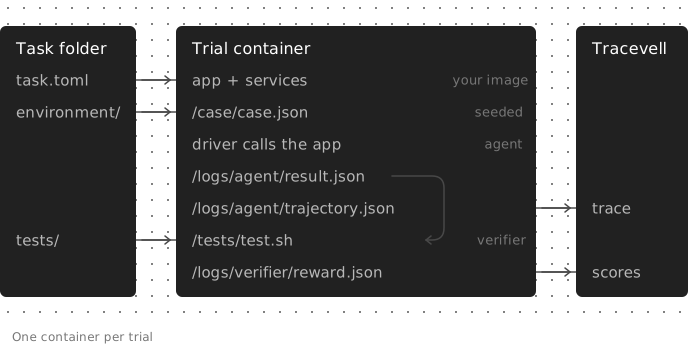
Each trial gets a fresh container from your image. The case data goes in when the container starts, the verifier's files only when it runs. The trajectory and the reward come back to Tracevell.
What a suite is made of
Harbor’s vocabulary maps onto evals of your own product like this:- Task (case): one scenario. A directory with a
task.toml(which image, resources, timeouts), aninstruction.md, the case’s data inenvironment/, and a verifier intests/. In production evals, tasks are variations of the same scenario: same code and services, different data. - Environment: the container where a trial runs, started from one image that holds your app and its services. The task’s
environment/files are copied into it at the start. - Agent: the code that drives the trial. In Harbor’s original use this is a general-purpose agent like Claude Code. In agent evaluations of your product, it’s a thin class that starts your stack, seeds the case, and calls your app’s entry point.
- Verifier:
tests/test.sh, run after the agent finishes. It grades the result with a check, a rubric, or an LLM judge, and writes a reward, such as1or0. - Trial: one attempt at one task: start the environment, run the agent, run the verifier. Run a task several times with
--n-attemptsto measure variance. - Suite: a directory in
evals/with aharbor.yaml(a Harbor job config) and its tasks. Most projects have one suite. - Trajectory: the app’s LLM calls and tool calls during the trial, shown in the trial’s trace.
Where each piece shows up in Tracevell
Each concept maps to something you can open in Tracevell:
The trace shape and how retries, crashes, and cancellations are counted are the same as for the Harbor integration.
Next steps
Quickstart
Have your coding agent set up a suite, or build one by hand.
The evals folder
Reference for
lmnr.yaml, harbor.yaml, task.toml, and secrets.Compare runs
Every run of a suite is charted in its group. Diff two runs side by side to see which cases regressed.
Harbor integration
Already running
harbor run on a benchmark? Add the Tracevell plugin directly.